
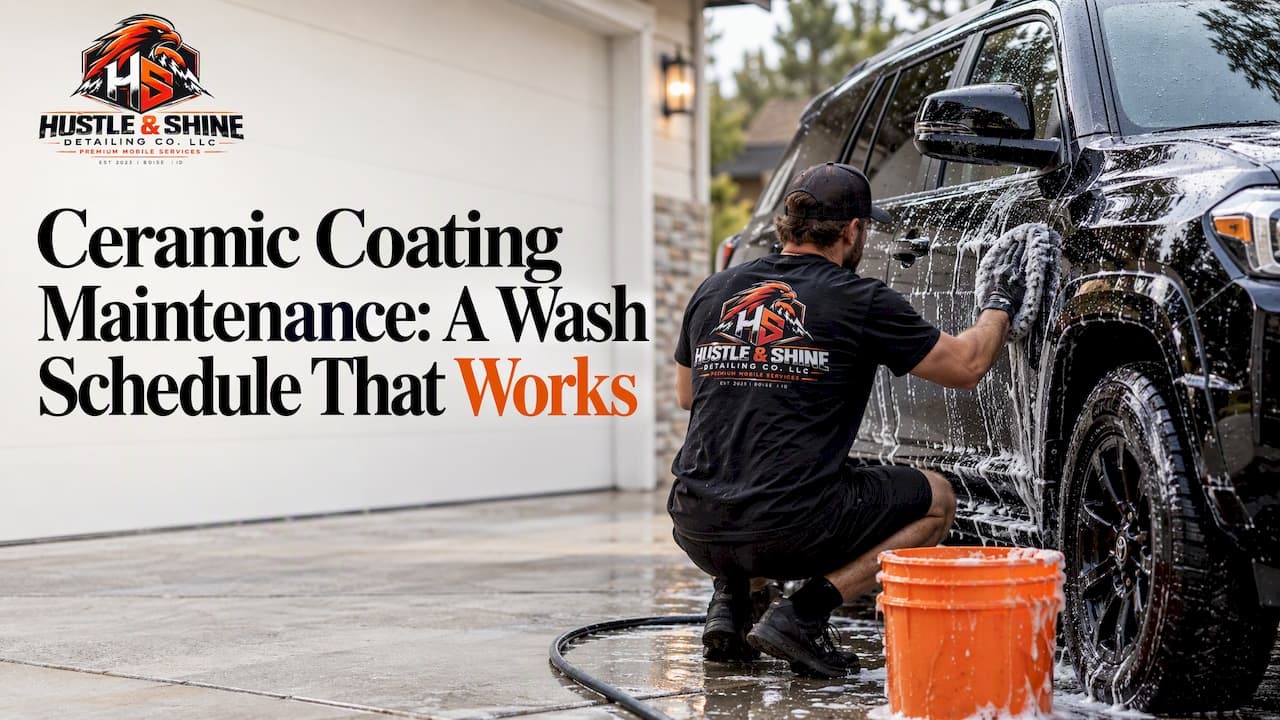
A ceramic coating is not maintenance-free. Plan on a gentle wash about every two weeks with a pH-neutral soap, a clean drying method, a SiO2 booster every few months, and a periodic check for bonded contamination. Skip those, and a coating that could last five years may be tired in two or three. Below is the routine, the reasoning behind each step, and what changes in a dry, dusty, hard-water place like the Treasure Valley.
TL;DR
- Wait one to two weeks after installation before the first wash, and only wipe off fresh dirt with a light detail spray and clean microfiber until then.
- Wash roughly every two weeks with a pH-neutral shampoo, a two-bucket or foam method, and a soft drying towel. Gentle beats frequent.
- Add a SiO2 booster every three to four months, and decontaminate (iron and mineral removal) when beading fades, before you think about recoating.
- Avoid automatic brush washes, harsh degreasers and dry wiping. Park in a garage or shade when you can.
- Hard water spotting is the Boise-area problem to plan around: dry the car right away and avoid washing in direct sun.
Table of Contents
- What a coating does and does not do
- The first two weeks: cure time
- How often to wash a ceramic coated car
- Choosing the right soap
- Washing step by step
- Drying: where most spotting starts
- Boosters and toppers
- When beading fades: decontaminate before you recoat
- What to avoid
- Longevity: what maintenance is worth
- Maintaining a coating in Boise and the Treasure Valley
- Our take on coating care
- Let us handle the upkeep
- FAQ
- Sources
What a coating does and does not do
A ceramic coating is a thin, hard, chemically bonded layer on top of your clear coat. It makes the surface slick, adds gloss, and helps dirt release. It does not make paint scratch-proof, and it does not clean itself. The manufacturers say as much: Ceramic Pro's own aftercare page states the coating is not bulletproof and needs routine aftercare, and following the maker's procedures is what keeps your vehicle eligible for the warranty.
A warranty is also narrower than most owners assume. One installer-side explanation of coating warranties notes that it covers the coating itself against problems like excessive gloss loss, chipping, peeling or fading. It does not promise perpetual water beading or a flawless surface forever. Your maintenance habits decide how the coating looks in year three, not the number on the certificate.
The first two weeks: cure time
A fresh coating needs time to harden. Ceramic Pro's guidance is to hold off washing for the first one to two weeks, because exposing an uncured coating to water, rain or high humidity can cause water spotting and hurt durability. Always follow the specific instruction from whoever installed your coating, since cure times vary by product.
What to do in that window:
- Keep the car in a garage or covered spot if possible.
- If a bird dropping or bug lands on the paint, remove it right away with a light detail spray and a clean, soft microfiber towel. Lift, don't scrub.
- Don't apply wax, sealants or other products on top.
- Skip the car wash entirely, including touchless.
How often to wash a ceramic coated car
Sources differ slightly, and the differences are worth understanding.
- Dr. Beasley's maintenance guide points to washing coated vehicles about every two weeks, or as needed, to prevent salt, bird droppings, tree sap and mineral deposits from bonding to the surface.
- Gtechniq argues you shouldn't have to wash weekly, and warns that coatings are only a few microns thick, so poor wash media can add light marring to the coating itself. Quality, low-contact washing matters more than frequency.
Put together: every two weeks is a sound default for a daily driver. Wash sooner when something corrosive or sticky lands on the paint. Stretch to a month for a garaged weekend car, and don't wash weekly with a gritty mitt just because the car looks a little dusty. A rinse-only or light touch-up in between is fine.
A simple schedule
| Task | Typical timing | Notes |
|---|---|---|
| Spot-remove bird droppings, sap, bugs | As soon as you see them | Detail spray and soft microfiber |
| Maintenance wash | About every 2 weeks | pH-neutral soap, two-bucket or foam |
| Undercarriage and wheel wells rinse | Monthly, more in winter | Matters most where roads are salted |
| SiO2 booster or topper | Every 3 to 4 months | Follow the product label |
| Decontamination (iron, mineral removal) | When beading or gloss drops | Before any recoat decision |
| Professional inspection | Yearly | Check beading, feel paint for roughness |
Choosing the right soap
The most searched question on this topic is about pH-neutral soap, and the answer is straightforward. A pH-neutral shampoo cleans without stripping the slick, water-shedding top layer. Chemical Guys' wash guide calls pH-neutral shampoo the rule for coated cars, and says harsh or acidic cleaners can strip hydrophobic properties.
What to look for on the bottle:
- "pH neutral" or "coating safe" stated plainly.
- No wax-stripping degreaser claims, no "strong cleaning" dish-style formulas.
- Good lubricity, meaning it feels slippery between your fingers. Lubrication is what protects against marring.
- SiO2-infused "ceramic" shampoos are optional. They can add a little top-up each wash, but they don't replace a booster.
Dish soap, household cleaners and heavy all-purpose degreasers are the common mistakes. They can clean the surface, but they work against the coating's slickness.
Washing step by step
- Start in the shade, on a cool panel. Hot paint dries soap and water before you can rinse, which leaves spots.
- Rinse thoroughly first. Knock off loose grit before anything touches the paint. Wheels and lower panels are dirtiest, so rinse those well.
- Foam or pre-soak if you can. A foam cannon or pre-wash spray lifts grit so you drag less of it across the paint.
- Two-bucket wash. One bucket with soap, one with clean rinse water. Load the mitt, wash a panel, rinse the mitt in the clean bucket, reload. Work top to bottom.
- Use a soft, clean wash mitt. Swap it out if you drop it. A dropped mitt carries grit.
- Rinse completely. Let water sheet off. A well-coated surface drains quickly.
- Dry right away. See below.
Drying: where most spotting starts
Water left to evaporate leaves minerals behind. On a coated car, those mineral deposits sit on top of the slick layer and can mute beading. Dry with a plush microfiber drying towel, or use a leaf blower or car dryer to push water out of mirrors, badges and door jambs. Many owners add a drying aid or detail spray while the panel is still damp, which makes drying smoother and adds a little protection each time.

Be gentle. Pat or drag the towel flat across the panel without pressure. Wash and dry towels separately, with no fabric softener, because softener clogs microfiber.
Boosters and toppers
Coatings wear at the surface first. UV exposure and repeated wash cycles gradually reduce how strongly the surface repels water. A SiO2 booster spray every three to four months is a common recommendation, and CarCareTruth says boosters restore the top layer's water repellency and can extend the coating's functional life by roughly 20 to 40 percent compared with going un-boosted.
Use the product as labeled, on a clean and dry car, in thin coats. More is not better. Overapplied booster streaks and can look blotchy, and it's the most common cause of the "my coating looks worse" complaint.
When beading fades: decontaminate before you recoat
Owners often decide a coating has failed when water stops beading in tight, tall droplets. Often the coating is fine and the surface is dirty. Installers quoted in CarPro's discussion of warranties describe restoring performance through inspection and decontamination, using iron removers or mineral-deposit removers, rather than reaching for polishing or a new coating layer.
A quick self-check after a wash:
- Water test. Does water sheet and bead uniformly, or does it cling in patches?
- Touch test. Run your fingertips over clean, dry paint inside a thin plastic sandwich bag. Gritty or rough means bonded contamination.
- Look for purple bleed. An iron remover turns purple when it reacts with embedded iron particles. That tells you contamination was there.
If the car passes those and still looks dull, ask a professional to inspect before you pay for anything. That is the same logic the CarPro piece recommends: choose an installer who looks at the surface and tests beading, instead of one who just collects a reapplication fee to keep a warranty active. Check your own warranty terms either way, because some require annual inspections or specific products.
What to avoid
- Automatic brush washes. Spinning brushes carry grit from other cars, which can mar the coating. If you must use an automatic wash, a touchless one is the lesser evil, though its stronger chemicals aren't ideal.
- Dry wiping. Dusting paint with a dry towel drags particles across it.
- Polishing a coated surface. Polishing removes the coating. Fix defects with a professional who knows what's under the surface.
- Strong solvents, degreasers and acidic wheel cleaners on paint. Rinse any overspray quickly.
- Sun-baked washing. Leads to spots and film.
- Letting contamination sit. Bird droppings, tree sap and bugs are acidic or sticky and can etch or bond.
Longevity: what maintenance is worth
Lab-rated years rarely match the real world. CarCareTruth reports that an outdoor-parked daily driver may see only about 2.5 to 3 years from a coating that could last five or more when garaged and washed with a two-bucket routine. Westchester Auto Detail makes a similar observation: disciplined owners can reach five or more years, while those with irregular washing often need a full reapplication after two to three.

Those are one installer's and one guide's observations, not guarantees, and the numbers vary by product, prep quality and climate. The pattern is what matters: consistent, gentle care is the cheapest way to get more years from a coating.
Maintaining a coating in Boise and the Treasure Valley
The advice above is national. Here is how it applies locally, based on how this climate behaves.
- Hard water and sprinklers. Water in much of southwest Idaho carries minerals, and lawn sprinklers hit driveways and parked cars all summer. Mineral spots bake on in strong sun. Wash in shade, dry immediately, and consider a mineral-deposit remover if spots linger.
- Dust and summer sun. Long dry stretches mean a dusty film and intense UV. A booster on schedule helps offset UV wear. Rinse before wiping.
- Winter roads. When crews salt or use de-icers, rinse the undercarriage and wheel wells. Westchester Auto Detail recommends a monthly undercarriage rinse where road salt is used, to limit rust and accelerated wear in high-exposure areas.
- Parking. Garage or shade parking is a real durability gain, because UV and mineral-heavy rain are among the biggest outdoor stressors.
Our take on coating care
We're a mobile detailing service, so we see cars at their owners' homes, workplaces and lots, and the same pattern repeats: the owners who are happiest with a coating are the ones who treat it like paint, not like armor. They wash gently, dry right away, and ask for an inspection before assuming something went wrong.
Two habits we'd push hardest. First, skip the brush car wash. It's convenient and it's the quickest way to add haze to a coating. Second, when beading drops, decontaminate before you recoat. A coating that looks dead is often just dirty, and spending on a new layer over contamination is wasted money.
We also think owners deserve straight communication. When you book with us, you deal with the owner from first inquiry to finished job, so you can ask what your car actually needs rather than being sold a package. Sometimes that answer is a simple maintenance wash and nothing more.
— Joshua
Let us handle the upkeep
If you'd rather not spend a Saturday on your coated car, we come to your home, workplace or business in Boise and the Treasure Valley. Our mobile detailing services include exterior washes, full details, ceramic coating and paint correction. Interior detail is listed at 100 to 180 USD one-off. We serve nearby areas too, including Meridian, Eagle, Nampa and Star. Running several vehicles? See our fleet detailing option.
FAQ
Do ceramic coatings need maintenance?
Yes. A coating reduces how much work washing takes, but contamination still bonds to it and wash chemistry still wears it. Regular gentle washing, a periodic booster and occasional decontamination are what keep its water-shedding and gloss performance up.
How long after ceramic coating can I wash my car?
Generally one to two weeks, per Ceramic Pro's aftercare guidance, though your installer's product may differ. Until then, remove fresh dirt with a light detail spray and a clean microfiber, and keep the car out of rain if you can.
Do you need to recoat a ceramic coating?
Not necessarily on a schedule. Coatings eventually wear, and outdoor daily drivers may need attention after a few years, but loss of beading often comes from surface contamination that decontamination can fix. Have it inspected first, and read your warranty to see what it requires.
Can I use any car soap on a coated car?
Use a pH-neutral shampoo made for car paint. Avoid dish soap, degreasers and acidic cleaners, which can strip the slick surface layer and leave it less water repellent.
Sources
- Ceramic Pro: Aftercare for ceramic coatings
- Dr. Beasley's Ceramic Coating Maintenance Guide (PDF)
- Gtechniq: Weekly washing?
- CarCareTruth: How long ceramic coating actually lasts
- CarPro: Ceramic coatings, warranties and the truth
- Westchester Auto Detail: Year-round coating maintenance
- Chemical Guys: How to wash a ceramic coated car